An unreadable edition of George Orwell’s 1984 exists—and that’s exactly the point. Here’s why this sealed book is the most important statement about censorship you’ll see this year.
So why did they do it? Here’s how George Orwell’s double-bound 1984 is protesting censorship.
Jayne Turner – Staff Writer
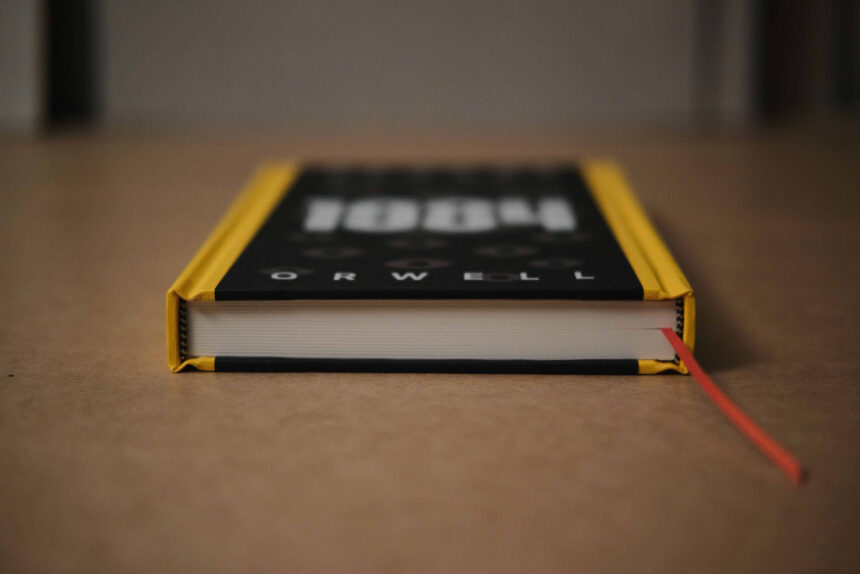
Though the book can’t be read or even opened, it’s impossible to overlook. According to Karan You can’t open it. You can’t flip through its pages. You can’t read a single word.
And that’s what makes it brilliant.
Designer Karan Nair created an edition of 1984 that’s completely sealed—a book transformed into a brick of compressed ideas you can hold but never access. It’s designed to trigger something primal: anxiety, then fear, then finally—action.
The message? While this book is unreadable by design, countless others worldwide are unreadable by force. Banned. Burned. Silenced.
And that should terrify you.
Censorship Deserves the Middle Finger
Let’s be blunt: Banned books are silenced voices. Full stop.
Authors write to express themselves, to explore what it means to be human, to scream their truth into the void and hope someone hears it. When you ban a book, you’re not just hiding words on paper—you’re erasing entire perspectives, lived experiences, uncomfortable truths that someone in power would rather you never encounter.
George Orwell understood this. In 1949, fresh off World War II, he watched the Soviet Union emerge as a global superpower and thought, This is how freedom dies.
So he wrote 1984.
He never directly name-drops the USSR in the novel, but come on—the oppressive surveillance state, the suffocating political culture, the cult of personality around Big Brother? It’s all there, barely disguised. Orwell held up a mirror to Soviet totalitarianism and forced the world to stare into it.
A Warning We Ignored
1984 isn’t subtle about its message: this is what happens when governments have too much power.
Control language, and you control thought. Suppress truth, and you create a malleable reality. Strip away personal freedoms one by one, and suddenly you’re living in a nightmare where the state monitors your every move, rewrites history on the fly, and convinces citizens that slavery is freedom.
Remember “War is Peace”? “Freedom is Slavery”? “Ignorance is Strength”?
These aren’t just creepy slogans—they’re propaganda techniques that actually work. Read a lie enough times, and your brain starts to accept it as truth. That’s not fiction. That’s neuroscience weaponized by authoritarians.
Through mass surveillance, relentless propaganda, and systematic manipulation, Orwell’s totalitarian regime maintains absolute control. The Party doesn’t just want obedience—it demands you love your oppression.
Sound extreme? Keep reading.
Orwell Was Right
Here’s the uncomfortable part: Orwell absolutely nailed it.
Post-WWII, the Soviet Union basically used 1984 as an instruction manual. Repression? Check. Propaganda? Check. State-sponsored violence? Check. Aggressive censorship of dissenting voices? Double-check.
And before you think, “Well, that was then, this is now”—wake up.
The same patterns are playing out right now, across the globe. Books are being banned at alarming rates. Governments are monitoring digital communications. Truth is being rebranded as “misinformation” by whoever holds power. History is being rewritten in real-time on social media.
We’re not reading 1984 as a warning anymore. We’re living in its early chapters.
Why This Matters
Nair’s sealed book isn’t just art—it’s activism. It forces you to confront what censorship actually means: the permanent loss of ideas, perspectives, and truths.
Every banned book represents a conversation we’re not allowed to have. Each censored author is a voice we’ll never hear. Every “dangerous” idea locked away is a potential solution to problems we can’t solve because we’re too afraid to think differently.
Censorship isn’t about protecting people. It’s about protecting power.
And the only way to fight it is to refuse—refuse to accept bans, refuse to stay silent, refuse to let anyone decide what you’re allowed to read, think, or say.
Orwell gave us the blueprint for recognizing tyranny. Nair gave us a physical reminder that it’s happening.
Now what are you going to do about it?
This Isn’t the First, and Won’t Be the Last
This project marks the beginning of The Bound Books Project, which hopes to spark conversation about censorship around the world. Though these double-bound books are not available for purchase, they are available to borrow, given that you live in Sweden. Through this program, maybe the rest of the world can catch up. Curious about banned books and censorship? The Dawit Isaak Database of Censorship catalogues literature from all over the world that has been banned or censored. If you can’t make it to Sweden, the database is online here.
Looking for more thought-provoking historical stories? Check out this article about the oldest man on earth.
So, what can we take away from 1984 without reading it? Censorship is real. It is here. And it is our responsibility as readers to reject it.
—
Author: Jayne Turner is a freelance writer from Orange, California. She has a bachelor’s degree in Neuroscience with an emphasis on language and cognition. She has ten years of musical theatre experience and a lifelong love of reading. Utterly excited by the brain, she brings a fresh Gen Z perspective to the topics that intrigue us most.